Browse retirement contributions and plan codes.
If you’ve spotted PX401 EEPRE on your paycheck stub, you’re likely dealing with a common payroll code related to retirement savings.
This comprehensive guide breaks down everything you need to know about the PX401 EEPRE deduction, including its meaning, tax implications, benefits, and how it fits into your overall financial planning.
Whether you’re an employee puzzled by your paystub or an HR professional seeking clarity, this resource positions itself as the go-to authority on PX401 EEPRE.
PX401 EEPRE Deduction: A Breakdown of the Code
PX401 EEPRE is a payroll abbreviation commonly used in systems like Paychex to denote a pre-tax employee contribution to a 401(k) retirement plan. Let’s dissect it step by step:
- PX: This prefix is often an internal identifier in payroll software (e.g., Paychex) for pretax deductions or specific plan types. It distinguishes this from other codes.
- 401: Refers directly to a 401(k) plan, which is an employer-sponsored retirement savings account under Section 401(k) of the Internal Revenue Code. These plans allow employees to save for retirement with potential employer matching.
- EE: Stands for Employee. This indicates the contribution comes from your paycheck, not from your employer.
- PRE: Means Pre-Tax. The deduction is subtracted from your gross pay before federal, state, and local income taxes are calculated, reducing your taxable income immediately.
Here is an example oof how it could appear on your paycheck:
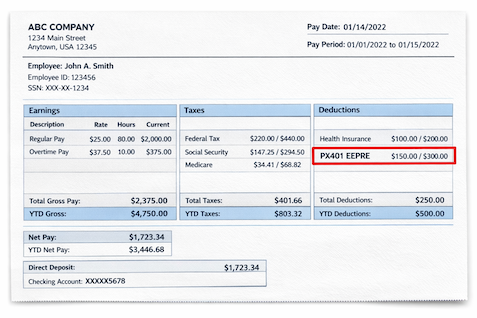
In essence, PX401 EEPRE represents your voluntary, pretax contributions to your 401(k), helping you build retirement savings while enjoying tax advantages. This code is specific to certain payroll providers but aligns with standard 401(k) practices across the U.S.
Why Does PX401 EEPRE Appear on Your Paystub?
Paystubs include this deduction for transparency and compliance. It shows:
- The amount contributed in the current pay period.
- Year-to-date totals for tracking against IRS limits.
- How it affects your net pay and taxes.
If your employer uses Paychex or similar systems, this code ensures accurate reporting to the IRS, especially on your W-2 form (where it appears in Box 12 with code “D” for elective deferrals).
The Benefits of PX401 EEPRE Contributions
Contributing via PX401 EEPRE isn’t just a line item—it’s a powerful tool for long-term financial security. Here’s why:
- Tax Savings: By deducting contributions pretax, you lower your current taxable income. For example, if you earn $60,000 annually and contribute 5% ($3,000), your taxable income drops to $57,000, potentially saving hundreds in taxes depending on your bracket.
- Tax-Deferred Growth: Money in your 401(k) grows without annual taxes on earnings (like dividends or capital gains). Taxes are only due upon withdrawal in retirement, often at a lower rate.
- Employer Matching: Many employers match a portion of your contributions (e.g., 50% up to 6% of salary). If your code includes something like PX401 ERMTCH, that’s the employer match—essentially free money.
- Compound Interest: Starting early maximizes growth. A $5,000 annual contribution at 7% average return could grow to over $1 million in 40 years.
- Protection from Creditors: 401(k) funds are generally protected in bankruptcy, adding a layer of financial security.
Potential Drawbacks to Consider
- Early Withdrawal Penalties: Withdrawing before age 59½ incurs a 10% IRS penalty plus income taxes.
- Required Minimum Distributions (RMDs): Starting at age 73, you must take annual withdrawals, which are taxable.
- Opportunity Cost: Money tied up in a 401(k) can’t be used for other short-term needs.
2026 IRS Contribution Limits for 401(k) Plans (Including PX401 EEPRE)
Staying within IRS limits is crucial to avoid penalties. For 2026:
| Category | Limit | Details |
|---|---|---|
| Employee Elective Deferrals (e.g., PX401 EEPRE) | $24,500 | Base limit for those under 50. |
| Catch-Up Contributions (Age 50-59 or 64+) | +$8,000 | Total: $32,500. |
| Super Catch-Up (Age 60-63) | +$11,250 | Total: $35,750 (if plan allows). |
| Total Employee + Employer Contributions | $72,000 | Includes matches and profit-sharing; up to $80,000 with catch-ups. |
These limits apply per employer. If you change jobs mid-year, you can contribute up to the limit at each. Note: Roth 401(k) contributions (post-tax) may appear as codes like PX ROTH 401 EE and count toward the same limits but offer tax-free withdrawals.
Sources: IRS announcements and updates from financial institutions like Fidelity and Vanguard.
Tax Implications: How PX401 EEPRE Affects Your Income
PX401 EEPRE reduces your federal and state taxable income but not Social Security or Medicare wages (FICA taxes). Example calculation:
- Gross Pay: $5,000 (bi-weekly)
- PX401 EEPRE Contribution: 6% ($300)
- Adjusted Gross for Taxes: $4,700
- Estimated Tax Savings (22% federal bracket): $66 per pay period
On your W-2:
- Box 1 (Wages): Reduced by the contribution amount.
- Box 12 (Code D): Total annual contributions.
This can also lower your Adjusted Gross Income (AGI), potentially qualifying you for other tax benefits like IRA deductibility or credits.
Comparison: PX401 EEPRE (Traditional 401(k)) vs. Roth 401(k)
| Feature | Traditional (PX401 EEPRE) | Roth (e.g., PX ROTH 401 EE) |
|---|---|---|
| Contributions | Pretax; reduces current taxes | Post-tax; no immediate reduction |
| Growth | Tax-deferred | Tax-free |
| Withdrawals | Taxed as income | Tax-free (if qualified) |
| Best For | High current tax bracket | Expecting higher taxes in retirement |
Choose based on your tax situation—many plans allow both.
How PX401 EEPRE Affects Your Taxable Income
When the code PX401 EEPRE appears on a pay stub, it normally represents an employee pre-tax contribution to a 401(k) retirement plan. The deduction is taken from gross pay before federal income tax is calculated.
Because the contribution is made before taxes are applied, it reduces your taxable income. This means you pay less income tax today while saving money for retirement.
For example, if an employee earns $70,000 per year and contributes 5% to a 401(k), the contribution lowers the income that is subject to tax.
Example calculation:
Gross annual salary
$70,000
401(k) contribution (5%)
$3,500
Taxable income after deduction
$66,500
If the employee is in a 22% tax bracket, the contribution could reduce income tax by roughly $770.
This is why many employers automatically enrol workers into retirement plans and show the deduction using codes like PX401 EEPRE on payroll statements.
Pre-tax retirement contributions are one of the most common payroll deductions because they allow employees to save for retirement while reducing current tax liability.
Example 401(k) Contribution Impact
Many employees want to understand how much their paycheck deduction actually represents over time. The PX401 EEPRE deduction simply reflects the percentage you choose to contribute.
Below are examples showing what common contribution rates look like.
Annual salary
$40,000
5% contribution
$2,000
Annual salary
$60,000
5% contribution
$3,000
Annual salary
$80,000
5% contribution
$4,000
These deductions are automatically calculated by payroll systems and then shown on the pay stub using deduction codes.
Over time, these contributions can grow significantly due to investment returns. Even modest contributions can accumulate into large retirement balances when invested over decades.
For example, contributing $300 per month to a retirement plan with a 7% annual return could grow to over $750,000 after 40 years.
This long-term growth potential is the main reason employers encourage participation in workplace retirement plans.
How Employer 401(k) Matching Works
Some employees notice the PX401 EEPRE deduction and also see a second line on their pay stub representing an employer match.
Employer matching means the company contributes additional money to the employee’s retirement plan based on the amount the employee contributes.
A typical matching structure may look like this:
Employee contributes
4% of salary
Employer matches
100% of the first 4%
If an employee earns $60,000 and contributes 4%, they contribute:
$2,400 per year
If the employer offers a full match up to 4%, the company also contributes:
$2,400 per year
This means the employee receives $2,400 in additional retirement savings simply for contributing to the plan.
Because of this, many financial advisors recommend contributing at least enough to receive the full employer match.
PX401 EEPRE vs Roth 401(k) Deductions
Some payroll systems show different codes for retirement contributions depending on whether the contribution is pre-tax or after-tax.
Traditional 401(k) contributions like PX401 EEPRE are pre-tax deductions.
Roth 401(k) contributions are after-tax deductions.
Traditional 401(k)
Contribution type
Pre-tax
Tax treatment
Reduces taxable income today
Payroll Systems That Use Codes Like PX401 EEPRE
Payroll systems typically use abbreviated codes on pay stubs because there are many different deductions that must be listed.
The code PX401 EEPRE is simply a short payroll identifier used by some payroll providers to represent a pre-tax employee 401(k) contribution.
Common payroll platforms that display similar deduction codes include:
ADP
Paychex
QuickBooks Payroll
Gusto
Paylocity
Workday
Each payroll platform uses its own naming conventions, but most retirement deductions include references to:
401
EE (employee contribution)
PRE (pre-tax deduction)
Because of this, employees may see slightly different variations of the code depending on the payroll system used by their employer.
How Much Should You Contribute to a 401(k)
Financial planners often recommend contributing at least enough to receive the full employer match, because this is essentially free retirement money.
A common guideline is:
Minimum contribution
Enough to receive full employer match
Moderate retirement savings strategy
10–15% of income
Aggressive retirement strategy
15–20% of income
Even small increases in contributions can have a major impact over time because of compound investment growth.
For example:
Monthly contribution
$250
Average investment return
7% annually
After 30 years
Approximately $300,000
After 40 years
Over $600,000
This illustrates how payroll deductions like PX401 EEPRE can build significant retirement savings over time.
Other Pay Stub Codes Related to Retirement Contributions
Employees reviewing their pay stubs may notice additional codes related to retirement plans or payroll deductions.
Some common examples include:
PX401 ER
Employer retirement contribution
PX401 ERMTCH
Employer matching contribution
PX401 EECU
Employee catch-up contribution for workers over age 50
401 PRE
Pre-tax employee retirement deduction
401 POST
After-tax retirement contribution
While the exact wording may vary between payroll providers, these codes all represent different types of retirement contributions or employer matches.
How to Manage or Adjust Your PX401 EEPRE Deduction
- Enroll or Change: Log into your employer’s benefits portal (e.g., Paychex Flex) or contact HR. Changes often take effect next pay period.
- Opt Out: Yes, it’s voluntary. But consider the lost tax benefits and potential employer match.
- Rollovers: If leaving your job, roll over to an IRA to avoid taxes/penalties.
- Loans/Hardships: Some plans allow borrowing up to 50% of vested balance (max $50,000) or hardship withdrawals, but with caveats.
Common Related Payroll Codes
- PX401 ERMTCH: Employer match to your 401(k).
- PXCMP EE PRE: Often pre-tax medical insurance premiums (similar structure but for health benefits).
- PX401 EECU: Catch-up contributions for those 50+.
- PX ROTH 401 EE: Roth (post-tax) 401(k) contributions.
If you see variations, check your payroll provider’s glossary.
Frequently Asked Questions (FAQs) About PX401 EEPRE
What does PX401 EEPRE mean on my pay stub?
It’s your pre-tax employee contribution to a 401(k) plan, deducted before taxes to lower your taxable income.
Is PX401 EEPRE mandatory?
No, it’s voluntary, but many employers auto-enroll new hires at a default rate (e.g., 3-6%).
How does PX401 EEPRE affect my taxes?
It reduces taxable income now; taxes are deferred until retirement. It doesn’t impact FICA taxes.
What’s the difference between PX401 EEPRE and PX401 ERMTCH?
EEPRE is your contribution; ERMTCH is your employer’s matching funds.
Can PX401 EEPRE contributions be Roth (post-tax)?
No, EEPRE is specifically pre-tax. Roth would use a different code like PX ROTH 401 EE.
What if PX401 EEPRE is deducted incorrectly?
Contact HR or payroll immediately for adjustments. Errors can be corrected via amended paystubs.
Does PX401 EEPRE count toward IRA limits?
No, 401(k) and IRA limits are separate. You can contribute to both if eligible.
How do I maximize my PX401 EEPRE contributions?
Aim for at least enough to get the full employer match, then increase as your budget allows, up to IRS limits.
Why is PX401 EEPRE on my W-2?
It’s reported in Box 12 (Code D) for IRS tracking of retirement contributions.
Is PX401 EEPRE the same across all payroll systems?
No, it’s Paychex-specific, but equivalent to “401(k) Pre-Tax Deduction” in systems like ADP or QuickBooks.
Can I contribute to PX401 EEPRE after age 50?
Yes, with catch-up limits: +$8,000 in 2026 (or +$11,250 if 60-63).
What happens to PX401 EEPRE if I change jobs?
You can leave it, roll it over, or cash out (with penalties if under 59½).
How does inflation affect PX401 EEPRE limits?
The IRS adjusts limits annually based on cost-of-living; they increased from $23,500 in 2025 to $24,500 in 2026.
Are there income limits for PX401 EEPRE?
No phase-outs like Roth IRAs; anyone with a 401(k) plan can contribute up to the limits.
This guide is based on current IRS rules as of 2026. For personalized advice, consult a tax professional or financial advisor. By understanding and leveraging PX401 EEPRE, you’re taking a proactive step toward a secure retirement.